Introduction
A number of appliances are available these days for the correction of unfavourable sagittal skeletal relationships.
An unfavorable sagittal pattern being referred here is a Class II skeletal pattern which requires an early intervention and correction.(1,2,3) At an early age both patients and clinicians have better options to bring about growth modulations, with myofunctional appliances, like Activator, Bionator, Twin Block, Frankels Functional Regulator etc.(4,5,6)
The key to the success of any such treatment lies in the correct choice of the appliance and more importantly retention of the achieved corrections.(7,8)
Diagnosis and Treatment
Here is a case of an 8 year old female patient who presented with mixed dentition, Class II dental and skeletal pattern, and mild crowding upper and lower anteriors. On Clinical and cephalometric examination maxilla appeared normal in length and size but the mandible was deficient mandibular length by 7 mm. Clinical examination showed that the VTO was positive.
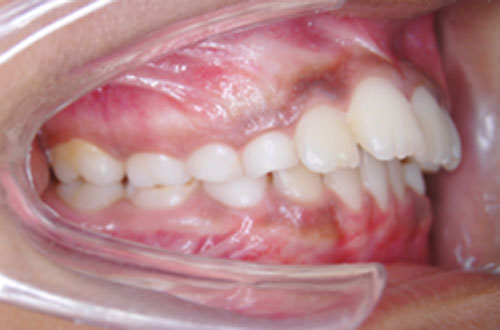
Figure 1
Endon molar relation
A two phase treatment was planned, in the first phase the sagittal correction was brought about followed by the second Phase where the dental corrections with fixed mechanotherapy were carried out.
Treatment progress and Retention
Phase one correction was achieved using, removable Twin Block Appliance Therapy, the active therapy extended to 8 months followed by 6 months of support phase during which time the appliance was selectively trimmed and finally the retention of the achieved correction was carried out for another 6 months with the same appliance.
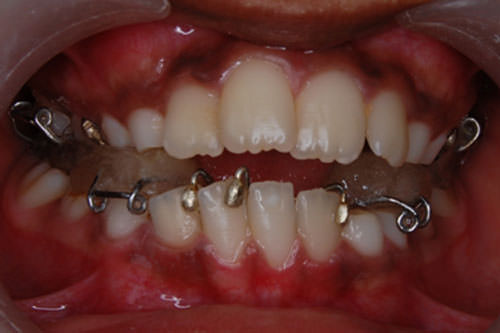
Figure 2
Twin Block appliance for sagittal correction
Having achieved the sagittal correction, dental corrections were initiated.
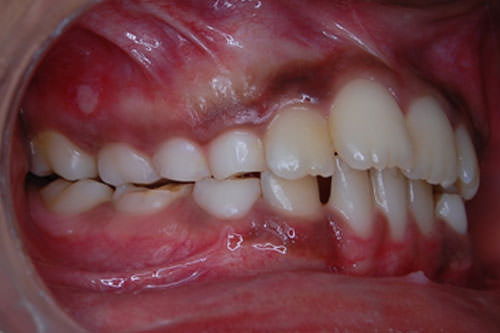
Figure 3
Overcorrected sagittal relation (Prior to dental correction).
Technique and Appliance design
Phase two, dental corrections were initiated with 2x4 Pre-adjusted edgewise appliance (since the patient was in mixed dentition).
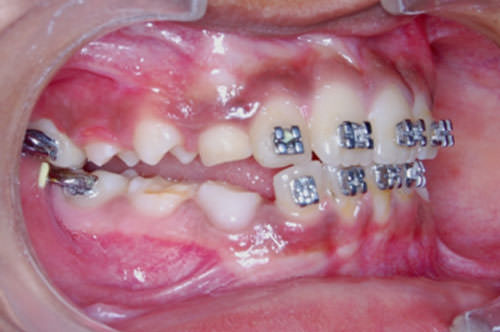
Figure 4
2x4 Appliance bonded.
A custom formed 0.016" AJ Wilcock stainless steel with cuspid circles was the arch wire of choice along light force Class II elastics.
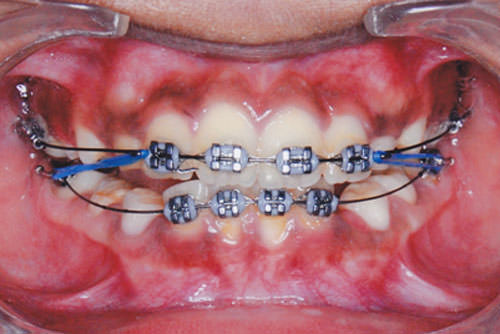
Figure 5
Class II elastics engaged from the upper cuspid circles to the lower molar tube hooks for retention of the Class II sagittal correction.
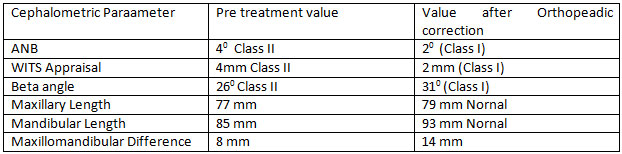
Cephalometric findings.
Figure 1
Endon molar relation
Advantages of the technique and appliance design
At the end of the retention phase of the Twin Block therapy, sagittal correction with an improvement in profile was appreciable, but a satisfactory inter cuspation of molars did not exist, this was due to the slight sagittal over correction. Fearing a relapse, long term retention had to be planned throughout phase two or at least till a good inter cuspation of molars was established.
The custom formed 0.016" AJ Wilcock stainless steel arch wire with cuspid circles was flexible in relieving crowding and rigid enough to prevent deflection of the arch wire or arch form under the influence of light force Class II elastics.
Within two months crowding was relieved and at the same time light force Class II elastics which were engaged from the upper cuspid circles to the lower molar tube hooks retained the achieved sagittal correction.
We intend to continue with this technique till a tight intercuspation is established or until all the permanent teeth erupt, after which active orthodontic therapy would commence.
The key to the success of this treatment, was the extra ordinary cooperation of this young patient throughout both phases of the treatment.
Conclusion
This simple but yet an efficient technique proved clinically applicable to all such cases where dental correction followed sagittal correction, especially in mixed dentition cases.
This retention technique can be actively employed until all permanent teeth erupt or atleast till the first permanent molars make a thorough intercuspation.
References
- McNamara Jr, J.A and Carlsan D.S - Quantitative analysis of Temperomandibular Joint adaptations to protrusive functions. Am. J. Orthod.1979 (76) 593-611.
- Pertovic A, Stutzmann J, Gasson N - The final length of the mandible: Is it genetically determined? In Carlson D.S, ed, Craniofacial Biology. Ann Arbor: Monograph 10, Craniofacial Growth Series, Centre for Human growth and Development. The University of Michigan, 1981.
- McNamara Jr, J.A and Bryan F.A- Long term mandibular adaptations to protrusive function. An experimental study in Macaca Melatta. Am. J. Orthod and Dentofac Orthop.1981 (92) 98-100.
- Clark W.J - The Twin Block Technique. Am. J. Orthod and Dentofac Orthop.1988 (93) 1-18.
- Isaacson R.J, Lindauer S.J, Rubenstein L.K - Activating a 2x4 appliance. Angle Orthod. 1993(63) 17-24.
- Stangl D.A - Cephalometric analysis of six Twin Block patients, A study of mandibular (Body and Ramus) Growth and development. Funct Orthod 1997(14):4:6,8,14,17-19,21-22,24-25.
- Baccetti T, Franchi L, Toth L.R, McNamara Jr, J.A - Treatment timing for Twin Block Therapy. Am. J. Orthod and Dentofac Orthop.2000 (118) 159-170.
- Clark W.J - Twin Block functional therapy, 2nd ed. Mosby. 2002.