Introduction
An accurate assessment of growth pattern especially in the vertical direction is essential in the diagnosis, treatment planning and prognosis of orthodontic and dentofacial orthopaedic cases.
Based on the routinely used cephalometric parameters (FMA, SN-GoGn, Y axis, Facial axis and Jarabak ratio) patients are diagnosed as having Horizontal, Average and Vertical growth pattern. Depending on the growth pattern, specific treatment mechanics are planned.
During cephalometric analysis certain cases present with wide varied readings and not all the five parameters indicate a specific growth pattern. In such cases the clinicians remain confused as to which parameter to rely on to determine the growth pattern.
Therefore, a need arises to ascertain the most reliable parameter for a specific growth pattern.
FMA (Frankfort Mandibular plane angle) is a parameter of the Tweed Analysis.(1) It is formed at the intersection of the Frankfort plane (Po - Or) and the Mandibular plane (Go - Me).The mean value is 25 0 indicating average pattern, values lesser than the mean indicate horizontal growth pattern and greater values indicate vertical growth pattern.
SN-GoGn (Mandibular Plane Angle) is a parameter of the Steiner's Analysis. (2) It is an angle formed at the intersection of the cranial base line (line connecting Sella and Nasion) and the mandibular plane (line connecting Gonion and Gnathion). A Mean value of 32 0 indicates average growth pattern, lesser values indicate horizontal growth pattern and greater values indicate vertical growth pattern.
Y - Axis angle is a parameter of the Down's Analysis.3 This angle indicates the degree of downward, rearward or forward position of the chin in relation to the upper face. The Y - axis is measured as an acute angle formed by the intersection the line from Sella to Gnathion with the Frankfort horizontal plane. A mean value of 59.40 indicates an average growth pattern, a decrease in Y - axis indicates horizontal growth pattern and an increases in the axis indicates vertical growth pattern.
Facial Axis angle is a parameter of the McNamara Analysis. 4 The facial axis angle is the angle formed by the line constructed from the posterior superior aspect of the Ptm to Gnathion relative to the cranial base, which is represented by a line joining Basion to Nasion. In a balanced face (average growth pattern) the facial axis angle is 900, lesser values indicate vertical growth pattern and greater values indicate horizontal growth pattern.
Jarabak Ratio is a parameter of the Jarabak skeletodental cephalometric analysis.5
The ratio is obtained by the formula

The anterior facial height is measured from Nasion to Menton and the posterior facial height is measured from Sella to Gonion. Ratio between 62-65% indicate average growth pattern, ratio below 62% indicate vertical growth pattern and ratio above 65% indicate horizontal growth pattern.
Aim:
To determine the most reliable cephalometric parameters in assessing growth in vertical direction in all the three growth patterns (Horizontal, Average and Vertical growth pattern) when all cephalometric parameters do not indicate a definite growth pattern.
Materials and Method
In this study, 140 pre treatment cephalograms of patients aged between 18-26 years were examined, who had reported to the Department of Orthodontics and Dentofacial Orthopaedics. Yenepoya University, Mangalore.
As part of the pre-treatment (diagnostic) records, 8x10 inches lateral cephalograms are made. All lateral cephalograms are traced on 8x10 inches acetate matte paper with a 3H sharp drawing pencil.
The routinely used parameters (FMA (1), Sn-GoGn angle (2), Y - axis angle (3), Facial axis angle (4) and Jaraback ratio (5)) are constructed and measured on all the tracings. The cephalometric values of 20 patients were definitive with all five parameters indicating a particular growth pattern. But the remaining 120 tracings did not show a consistency of all five parameters.
These 120 subjects were classified into the three growth patterns Horizontal, Average and Vertical, based on the factors ratio The three groups consisted of 40 subjects each.
Subsequently, the percentage frequency of each of the five parameters was examined in all the three growth pattern groups.
The highest percentage frequency parameter in each of the three groups is considered the most reliable in assessing the growth pattern.
Results
The data was compiled using Microsoft Excel and Microsoft Word.
Table 1. Comprised of parameters used to determine Horizontal growth pattern. It was seen that SN-GoGn (95%) and Jarabak ratio (92.5%) presented the highest frequency in determining the Horizontal growth pattern, whereas, the other parameters presented with a comparatively lower frequency and FMA presented with the least frequency (55%).
Table 1
Percentage frequency of parameters in assessing Horizontal growth pattern
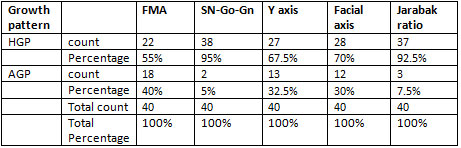
Table 2. Comprised of parameters used to determine Average growth pattern. It was seen that SN-GoGn and Facial axis presented the highest frequency of 82.5% respectively, in determining the Average growth pattern, whereas, the other parameters presented with a comparatively lower frequency and FMA presented with the least frequency of 60%.
Table 2
Percentage frequency of parameters in assessing Average growth pattern
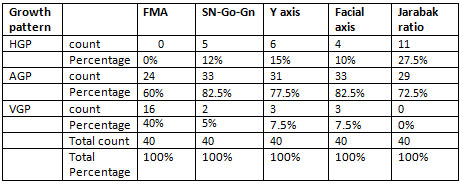
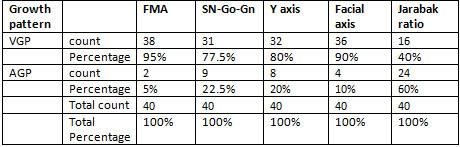
Table 3. Comprised of parameters used to determine Vertical growth pattern. FMA (95%) and Facial axis (90%) presented the highest frequency in determining the Vertical growth pattern, whereas, the other parameters presented with a comparatively lower frequency, with Jarabak ratio presenting with the least frequency of 60%.
Table 3
Percentage frequency of parameters in assessing Vertical growth pattern
Discussion
Assessing the growth pattern of any patient in vertical and anterio-posterior relation is most important in diagnosing, appropriate treatment planning and therby achieving stable results. In this study an attempt has been made to determine the most reliable parameter in assessing growth pattern in each of the three (Horizontal, Average and Vertical) growth patterns.
Among the five routinely used parameters in assessing growth, it was seen that, not all five parameters indicated a specific growth pattern. Example, in Horizontal growth pattern, some values indicated towards Horizontal growth pattern and some towards Average growth pattern, with the percentage frequency of each parameter drawn it was inferred that the most reliable parameters in assessing Horizontal growth pattern were SN-GoGn (95%) and Jarabak ratio (92.5%) followed by Facial axis (70%) and Y axis (67.5%) and the least reliable parameter was FMA (55%).
While assessing the Average growth pattern, some parameters indicated a Horizontal growth pattern and some showed Vertical growth pattern, from the percentage frequency table 2. It can be inferred that the most reliable parameters in assessing Average growth pattern were SN-GoGn and Facial axis (82.5%) followed by Y axis (77.5%) and Jarabak ratio (72.5%) and FMA was the least reliable (60%).
Similarly, assessment of Vertical growth pattern presented with certain parameters as indicating Average growth pattern, from the percentage frequency table 3, it can be inferred that the most reliable parameters in assessing Vertical growth pattern were FMA (95%) and Facial axis (90%) followed by Y axis (80%) and SN-GoGn (77.5%) and Jarabak ratio was the least reliable (40%).
Conclusion
From this study it concluded that -
- SN-GoGn and Jarabak ratio are the most reliable parameters in assessing Horizontal growth pattern.
- SN-GoGn and Facial axis are the most reliable parameters in assessing Average growth pattern.
- FMA and Facial axis are the most reliable parameters in assessing Vertical growth pattern.
- FMA is the least reliable parameter in assessing Horizontal growth pattern.
- FMA is the least reliable parameter in assessing Average growth pattern.
- Jarabak ratio is the least reliable parameter in assessing Vertical growth pattern.
References
- Tweed C.H: The Frankfort Mandibular Plane Angle in orthodontic diagnosis, classification, treatment planning and prognosis. Am J Orthod Oral Surgery. 1946; 32; 175-230.
- Downs W.B: Variations in facial relationships, their significance in analysis and treatment planning. Am J Orthod 1948; 34; 812 - 823.
- Steiner C.C: Cephalometrics for you and me. Am J Orthod 1953; 39; 729 -755.
- McNamara J.A. A method of cephalometric evaluation. Am J Orthod. 1984; 86; 449 -469.
- Jarabak J.R, Fizzell J.A: Technique and treatment with light wire edgewise appliance. CV Mosby: St. Louis.
- Braun S. C axis: A growth vector for the maxilla. Angle Orthod. 1999;69:539-542.
- Braun S. G axis: A growth vector for the mandible. Angle Orthod. 2004;74(3):328-331.
- Baik C.Y and Ververidou M: A new approach of assessing sagittal discrepancies: The Beta Angle. Am J Orthod Dentofac Orthop. 2004;126:100 -105.
- Alexander Jacobson: Radiographic Cephalometry. How reliable is cephalometric prediction? Quintessence publishing company, Inc. 1995:297-298.